
Honest Pricing vs. Hidden Costs: What Every Villa Buyer Should Ask Before Signing
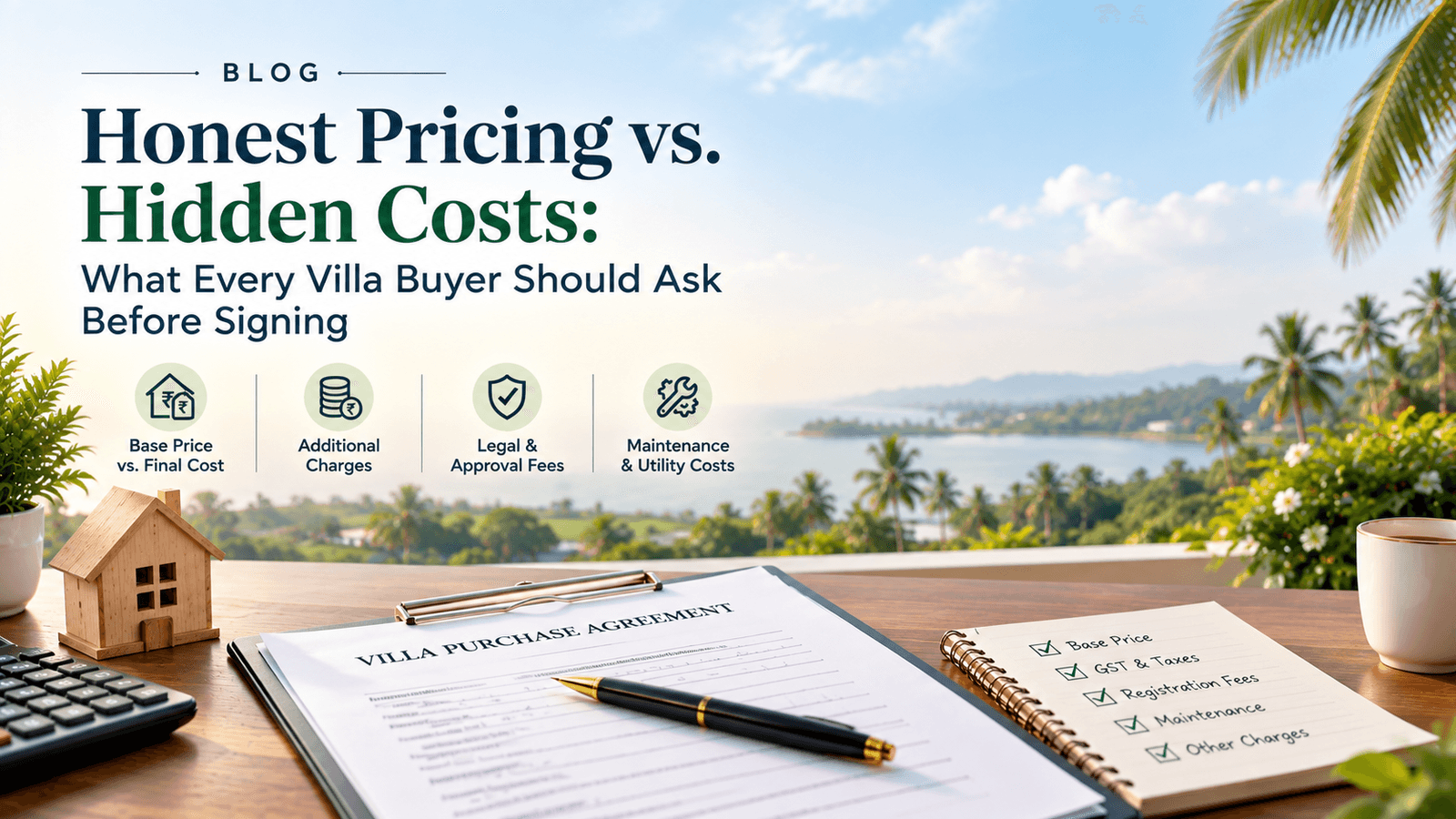
The quoted price on a villa brochure is rarely the price a family actually pays. Between the base construction cost and moving into a finished home sit a string of charges that many buyers only discover after they’ve already signed KSEB connection fees, KWA water line charges, land conversion costs, legal documentation, and more. Individually, each feels like a small “extra.”
Together, they can inflate a project’s real cost by a significant margin.
This is where the gap between a trustworthy developer and a risky one becomes clearest. It isn’t in the marketing it’s in whether the final invoice matches what you were told at the start.
Why “Hidden Costs” Exist in the First Place
Villa pricing in Kerala typically involves multiple layers, and each layer is often handled by a different party: the builder, the electricity board, the water authority, and the local registration office. When a developer quotes only the construction cost and stays silent on the rest, buyers are left to discover these costs one at a time, usually at the worst possible moment mid-project, when negotiating leverage is lowest.
The most common cost categories that get left out of early quotes include:
KSEB (Kerala State Electricity Board) connection charges new service connection fees, meter costs, and sometimes transformer or line-extension charges depending on the plot’s location
KWA (Kerala Water Authority) charges water connection fees and, in some areas, pipeline extension costs
Legal and documentation costs sale deed registration, stamp duty, land conversion certificates, and encumbrance verification
Statutory approvals building permit fees and panchayat/municipality charges
Finishing-stage additions fittings, fixtures, or specifications that were quoted as “basic” but assumed to be premium by the buyer
None of these are unusual costs. They’re standard parts of building a home in Kerala. The problem isn’t that they exist, it’s when they’re left out of the conversation until it’s too late to plan for them.
How to Calculate the Real Total Cost of Ownership
Before signing anything, a buyer should ask for a complete cost breakdown that separates every component clearly. A trustworthy developer will be able to answer each of these without hesitation:
What exactly is included in the quoted construction cost? Ask for the specification sheet flooring, fittings, electrical work, plumbing so “basic” and “premium” aren’t left to interpretation.
What are the KSEB connection charges for this specific plot? These vary based on distance from the nearest transformer and the sanctioned load, so a generic answer isn’t good enough, ask for a plot-specific estimate.
What are the KWA charges, and is the plot within an existing pipeline network? If not, ask who bears the cost of extension.
What legal and registration costs should be budgeted separately? Stamp duty and registration charges in Kerala are statutory and calculable in advance a transparent developer will walk you through them rather than leaving you to find out at the sub-registrar’s office.
Is there a written cost sheet, or only a verbal estimate? If it isn’t in writing, it isn’t a commitment.
A simple way to think about it: Total Cost of Ownership = Construction Cost + Utility Connections (KSEB + KWA) + Legal & Registration + Statutory Approvals + Any Site-Specific Costs (soil, access road, compound wall). Any developer unwilling to walk through each of these line items in writing is asking you to trust blindly.
Where CMR’s Approach Differs
CMR Developers operates as an ISO 9001:2015 certified organization, a certification that reflects documented, standardized processes rather than ad-hoc project management. In the context of pricing, that standardization matters directly: it means cost estimation, documentation, and client communication follow a consistent, auditable process rather than varying project to project or salesperson to salesperson.
This is the foundation of what CMR describes internally as its honest pricing philosophy, the practice of presenting the full cost picture upfront, including utility connections and legal paperwork, rather than quoting only the construction figure and letting the rest surface later. For a buyer, the practical benefit is simple: fewer surprises, and a budget that holds up from contract to keys-in-hand.
What to Ask Before You Sign
Before signing any agreement, ask the developer for:
A written, itemized cost sheet covering construction, utilities, legal fees, and approvals
Plot-specific KSEB and KWA estimates, not generic figures
A clear statement of what triggers additional charges (soil conditions, access issues, specification upgrades)
References from recent buyers who can confirm the final cost matched the initial quote
A developer confident in its pricing will welcome these questions. One that deflects them is telling you something important before the contract ever does.
Want a transparent, itemized cost breakdown for your villa project? Talk to CMR Developers and get honest pricing in writing before you sign.